Showing posts with label New Adult. Show all posts

Sunday, 1 February 2026

Bookshelves


So, Christmas has been and gone, and you’re left with book tokens you don’t know what to buy with or, far, far worse, the dreaded One4All card that allows you to spend in hundreds of different stores but none of which seem to allow you to or have anything remotely worth buying.

This is where I come in.

Maybe.

You see, I’ve got books for sale. Not the ones in the photo above; technically they are mine, because I own them, but they’re not my books.

You can buy my books from any bookshop, online or physical, including Waterstones for whom the One4All card is acceptable. You may need to wait a week or so as they may not be in stock, but you can still buy them. 

But which to buy?

Well. 

‘The Broken Bottle’, ‘How Green Are Your Eyes’ and ‘This Is Not The End’ are a trilogy of books aimed at readers from 12 to adult. Indeed, most of the readers seem to be adults, so you’ll be in good company. They tell the story of Wilf, a teenager in Croalworth, near Manchester, as he goes to school, forms a band, falls in love, gets scammed, gets involved in gun and drug crime, goes to Ireland, searches for an awol alcoholic, stumbles across an arms dump, is befriended by a mysterious girl, meets the most drunk stop/go sign holder in the world, goes home, goes to university, makes some new friends, finds his flatmate is a bit weird and unhinged, finds his bag mistaken for an unattended package by the bomb squad, is the victim of mistaken identity and rings his sister to take him home. 

https://books2read.com/b/3nBzEP

https://books2read.com/b/bPGOPl

https://books2read.com/b/m00DAA


‘Capturing the Wry’ and ‘Welcome To The Underachievers’ are memoirs of my time in actual real bands writing and recording actual real music and playing actual real gigs. Across the two you can read the trails and tribulations of nearly being signed to record labels, the highs and lows of playing in youth clubs, restaurants and universities, and marvel at just how many venues I have played gigs in which have now closed down and become housing developments.

https://books2read.com/b/3LVWp1

https://books2read.com/b/b5JlqO


‘Seasonal Adjustments’ is a poetry anthology. I once wrote a poem that came in the top 0.17% of a national competition, and still didn’t win. But it shows the potential quality, even if it is up to you to decide the actuality of it. ‘Out of Tune’ meanwhile is the cleverly-titled collection of lyrics presented without their tune. Do you see what I did there?

https://books2read.com/b/49LEaw

https://books2read.com/b/b5W5wk


‘The View From Orlando Bridge’ is another memoir, this time about supporting Bolton Wanderers in the 1980s and 1990s. Yes, it’s that bleak.

https://www.lulu.com/shop/john-hartley/the-view-from-orlando-bridge/paperback/product-m5z964.html?srsltid=AfmBOopiLnNATy_RPJS1AEiE2eEbyl3Ghqjk84MvuYSWnweTsQmh8kgm&page=1&pageSize=4

You can get all of these anywhere, really, including Amazon. You can also get signed copies of most of the titles directly from me at www.brokendownrecords.bandcamp.com/merch

So come on, don’t be shy. Spend those vouchers, or just your hard earned cash, and you too can have my books on your bookshelves (but not the ones in the photograph for reasons already established).


Sunday, 4 May 2025

The Book of Apologies: The Hair Puller


The playground was fun. At first it was just a great big square of tarmac, with a grass edge. At the opposite end of the playground to the classroom were grass mountains, which backed onto one of the old farms. Another farm provided the right hand border. We weren’t allowed on the grass mountains; not until the summer when we were then given permission to move from the knee-shredding gravel and onto the softer, more natural surface. Of course, by the time summer arrived we were older. Even a matter of a few months helped us realise that these grass mountains were nothing more than landscaped bumps. Not that we knew the word ‘landscape’ at that age. We did know the word ‘bump’ though; every time one of us poor young souls tripped over the shoelaces we could not yet tie, we would be treated to tea and sympathy (but without the tea) from the teacher on duty.


“Oh,” they would sigh, “have you bumped your knee?” or whichever part of our tiny anatomies it was. Of course we had: how else would you account for the blood and grit mound on the offending body part. We hadn’t learned sarcasm at that age, either, so would make do with a tearful grunt to the affirmative. These injuries led us towards the first meaningful play I can remember. Richard and myself would hurtle up to the far end of the playground from the classroom as fast as we could. Louise, who was in the year above us, wore her coat undone, with her arms out of the sleeves, and just the hood over her head to keep the garment in place. She wanted to be a nurse. Richard and I would take it in turns to invent an injury, which the young nurse could then treat. This was play at its most innocent. We were treated to concern and affection from Louise. Louise made playtimes something to look forward to: forward beyond the packet of potato puffs that would come with a free football card inside, the quarter pint bottle of milk that was always too warm to enjoy and the promise of ten minutes away from learning. I didn't want to learn. I wanted to play.


Within two years though we were moved up the school, into what was known as the middle building, being as it was the middle of three buildings. The middle building had its own playground. This was called the middle playground, being as it was the middle of three playgrounds. Here we were faced with older boys and girls who were inevitably bigger, stronger, louder and in charge of the playground. Playing football on the netball courts at playtime was the only way to mix. In the summer we were allowed to go onto the playing fields if it hadn’t been raining. Despite geography, it never seemed to be raining in those early summers.


It was on these playing fields that I made the fastest sprint of 100 yards possibly ever witnessed. Being June, the weather had been rather warm, and as we merrily played at lunchtime we were too engrossed to notice the storm brewing ahead. Nobody noticed the first flash of lightning. No one except me. It wasn’t even a flash: it lasted too long. I saw it from the far end of the field and immediately raced to the school end, where the dinner ladies were sitting on deckchairs making sure nobody maimed themselves on the goalposts. At this stage I still wasn’t completely at ease with the concept of thunder and lightning. I was only eight. By the time I had made it to the school end, the flash was still decorating the slate grey sky behind me. In a state of complete panic I pointed to the fork, which must have spread out across at least three miles on the horizon, and urged the dinner ladies to get us all inside, quick. Even at that tender age I

was worried that someone would get killed. Amazingly, the dinner ladies laughed off my concerns and told me not to be silly. (It wasn’t raining, so why go to all the effort of packing everything up?) After what had seemed like an age, the air was filled with the most tremendous rumble. Everyone bar no one - except the dinner ladies of course - screamed like they had never screamed before. That was nearly two hundred school children, a noise great enough to drown out the thunder. Only the threat of mass panic (as opposed to my solitary panic) prompted the dinnerladies into action, and we were immediately invited to return to our classrooms to read old copies of the ‘Beano’ and ‘Whizzer and Chips’, or to “draw a nice picture”. The storm lasted the whole afternoon and people not far away from the school were killed by the lightning. I hoped that had taught the dinnerladies a lesson in doubting my storm-spotting credentials. It certainly rained that afternoon too; it rained so hard the old mill a mile away disappeared, prompting some of us with more active imaginations to suggest it was a ghost mill. 


After a few years we again moved, this time to the upper playground. Here we had much more space for football. At the far end of the playground was a narrow blue iron gate, which was padlocked. Through the rails of the gate we could see the outside world. The outside world looked like a good place to be; the view from the wrong side of the walls (the school side) was of the village cricket pitch and the Rec; a slide, a roundabout and three swings. This was accompanied by a mass of lush, green grass and the vicarage wall, daubed with the message “Sex Pistols Rule U.K.” along with a letter ‘A’ in a circle. It was by these gates that we used to wait for the coach to take us for the weekly trip to the swimming pool (except for those with verrucas on their feet).


It was by these gates that I let slip my best friend Richard’s biggest secret: he fancied Sarah. He divulged his information whilst we were on the school trip to the Isle of Man. I swore myself to secrecy, but in the heat of a petty disagreement I chose to forget the concept of loyalty. For this I would apologise, but he got exact and immediate revenge by letting slip my biggest ‘secret’ (he’d been teasing me that I fancied Kevin at the time, though the truth of the matter was I’d only let it be known that my crush’s name began with a ‘K’) and the complete and utter embarrassment I endured was, I believe, punishment enough. At least he came out of the incident with dignity, and admitted his feelings. I backtracked instantly, denied all knowledge of the revelations, and wished I had never opened my big mouth. Never again would I divulge the deepest thoughts of a fragile heart. Well, not until the next time…


It was in the middle playground, however, that I faced my biggest shame. This was even an even bigger shaming than when I was pulled out of assembly for talking. I was only telling someone in front of me to shut up, because they were talking when they shouldn’t have been. Unfortunately, by being such a goody-goody, I too was talking when I shouldn’t have been, and it was me who got spotted. I was hauled to the front of the hall and given two great wallops by our corporal-punishment-favouring headmaster. I wet myself and pleaded to go to the toilet. I had only been trying to help. I wouldn’t ever learn. 


No, the biggest shame stemmed from the middle playground, at morning playtime. Fresh from that warm quarter pint of milk and the packet of crisps (although by now we had moved away from those packets with free football trading cards in them), a group of us played by the red brick wall that stood five feet tall and separated the playground from the classrooms. There must have been about ten of us, boys and girls, and we were playing tag. Darting around and weaving through each other’s random routes, avoiding whoever was ‘it’. By the law of averages, it ultimately became my turn to be ‘it’, and I leaped around trying to make enough contact with someone else to be free again. I got Paul. Which was fine, except that when Paul left the moment of contact, a wadge of his hair remained entangled in my fingers. I don’t know how it got there. Well, I do: I worked it out eventually. Obviously Paul was in a bit of pain, and I didn’t know what to do apart from say ‘I didn’t do it on purpose’; I didn’t. The game continued. Paul disappeared.


A few minutes later I found myself being pulled from the playground by my own hair, which was in the firm grip of the deputy head, Mr. Whelan. The new hall (which was the assembly hall, the gym and the dinner hall all in one) through which I was marched seemed much longer than usual and the corridor to the staff room much quieter. I think I panicked; I felt nauseous, as though I had just swallowed the contents of the stagnant pond into which I had fallen two years previously. When I fell into the pond (not deep, but very cold on account of it being covered in ice) I just got told I had been stupid and not to expect any sympathy. This time my protestations of innocence fell on deaf ears, and I was sentenced to a whole month’s ban from the playground. Technically, I suppose I wasn’t innocent: that I pulled out that hair was beyond all doubt. I did feel a little aggrieved, however, that the intent (or lack of it) was never brought into Mr. Whelan’s kangaroo court.


Despite my punishment (and it was some punishment: four weeks solitary confinement, nothing to do but write lines and complete extra maths work), I still feel a sense of injustice. However, that cannot compete with the pain that Paul must have felt when his follicles parted company with his scalp. For this pain, Paul,  I am sorry.


Text and images copyright John Hartley 2025


Sunday, 27 April 2025

The Book of Apologies: The Collector


The Collector


Going to my grandmother’s house was always something of an adventure. Not just because of where she lived, which was - or at least felt like it was - in the middle of nowhere. To reach her house we would get in dad’s car which rattled its way down winding oak-lined lanes behind which flat farmland stretched out to the coast and the sand plains of Southport, across an unmanned level crossing (which always carried with it an added sense of trepidation as there were no barriers, just a clanging bell and flashing lights to alert us to impending collision with a train full of daytrippers), down a narrow, twisty slope to cross a weir that would flood occasionally, then back up, then past a windmill or two before arriving at her cottage.


No, the adventure was more about what we would find when we got to her house. Technically, I suppose these days she would be classed as a hoarder, but the house was never like those you see on the television with rooms piled high with pointless peripherals, rotting food, a sock that has neither been worn nor washed since the 1950s, half a rat … There was order in my grandmother’s house. Loads of stuff, yes, piles and piles of it, but at least it was in order, and there was a definite point to it. My cousins described her as “eccentric”, which is possibly a gentle way of describing someone who is losing the plot. Grandmother wasn’t losing the plot, but neither was she conventional.


My grandmother was an avid reader, and bought books by the dozen. She kept the books on an array of different bookshelves, which lined every wall in every room except the kitchen, all higgledy-piggledy as there was no planning to the storage - she would just run out of space, visit a local jumble sale, and buy the biggest available bookcase they had on offer. To look at the bookshelves was a visual nightmare. There was no colour co-ordination, no thought to height or thickness and the impact this might have on the overall aesthetic. Not even any logical categorisation; it looked as though these hundreds, thousands of books were just randomly dumped, symptoms of a chaotic mind. 


However, this was not true. Indeed, my grandmother had a very specific logic. The logic started in the upstairs bedroom that had once been the bedroom of my dad (but, also, her own bedroom as a child), then next to it was that of his sister when she was born, then next to that their brother when he arrived, then winding along the landing and into the hall, into the front ‘sitting’ room, the dining room, then the back ‘living’ room before ending in the hall. Moving clockwise around each room from the doorway, the shelves contained every single book my grandmother had bought in chronological order of purchase. This was her logic: the books, she said, were her life story. You could pick a book at random and she would be able to tell you how old she was when she bought it, where she had bought it (with 90% accuracy) and what was going on in her world and the wider world at the time she bought it.


It wasn’t just books she kept though. In the now redundant bedrooms were piled high dozens and dozens of cardboard boxes, all containing collections of things that were important to her. The prized collection of Readers Digest could be found in several boxes stacked neatly in one corner, carefully positioned to create cardboard corridors within the room that were sturdy enough to not topple; across the gangway another stack containing every single copy of the Radio Times she had bought. Another box or six might contain postcards from places she had visited and holidayed at. Others still contained letters from cousins, friends, people she had met on holiday, some girl she had struck up a conversation with in the queue for an ice cream at Camber Sands in the 1920s … All of this, she said, was her life; her memories, prompts for when the day came that she lost her marbles and couldn’t remember anything. 


I suppose it was inevitable then that my dad would inherit this gene, although thankfully my grandfather’s DNA managed to dilute it somewhat. Dad’s collections were more manageable, and possibly sufficiently socially acceptable enough to not have him marked as ‘eccentric’ or, as his mother would say without any hint of irony, “one of those weirdos”. He collected cigarette cards even though he didn’t smoke, of footballers and cricketers and, perhaps not surprisingly given the copious amounts of tea drunk in our family, the cards that came in packets of Brooke Bond tea. It helped that Mr. Prince, who lived across the back street from us, had a job in the packing factory for them and he was able to secure the collection books and the odd bundle of cards to support the habit. 


Mum didn’t mind this level of collecting. She could see there was a point to it, and because the collections were all properly housed and cared for and, perhaps significantly, could fit together in boxes that could go up in the loft, out of sight. She didn’t mind either that Dad tried to pass down the love of collecting to me. He tried with stamps, but I really couldn’t be doing with those irritating bits of adhesive plastic that folded back on themselves to mount a small square of perforated paper which had what might be a lovely picture on it obliterated by a dirty black postmark into a book that told me that what I had just held was of valuable historical interest. The first set of stamps of Elizabeth II’s reign? Excuse me whilst I stifle a yawn. He tried with coins too, but they just made my hands feel grubby and it was difficult to keep them in any order. Sometimes I would get out the huge old coffee tin in which he kept them and empty it out onto the carpet - usually when Mum wasn’t there so she wouldn’t see the mess I made on the carpet; there were still rogue coffee grounds in the tin after thirty years - then sort them into chronological order, or country of origin. I would have to be very bored to do that though.


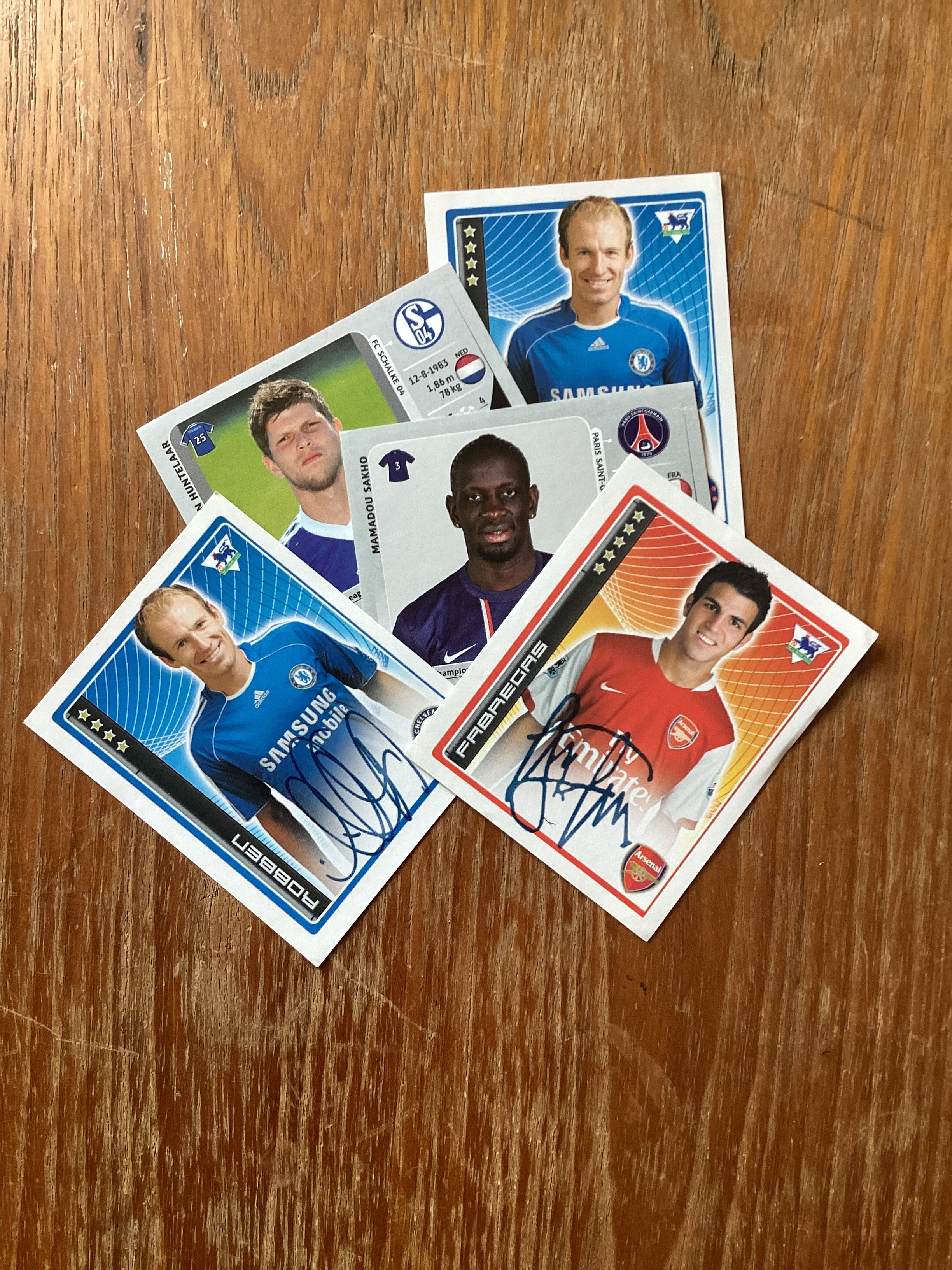
I did, however, begin to collect stickers when I got older. I must have been in my early teens when Smash Hits launched a sticker collection. They were probably inspired by the Panini football stickers that the boys at school collected although, much as I loved football, it was difficult for a girl to get engaged in the swap system for duplicates. I always knew I was getting mugged off; even though I knew that the rarity value of a Trevor Francis was worth at least four Raith Rovers double player stickers, I’d only ever be allowed to swap on a one-for-one basis. Consequently my collections were always incomplete and I remained unfulfilled. With the Smash Hits stickers I was at least able to trade on a level playing field, as both boys and girls were collecting them. This included my older cousin, Lucinda.


Lucinda was Dad’s sister’s eldest daughter, and despite Dad being the eldest of the siblings I was the youngest of the cousins. Lucinda was four years older than me, and was not unknown to pull rank if she needed to. One spring - it must have been Easter - we went to stay with them in their big house in the Yorkshire Dales. My collection of stickers was almost complete. So too was Lucinda’s. I think she had five left to get, whilst I had twenty one. At the back of the sticker book was an address you could write off to to get any stickers you were missing, by sending a postal order or a cheque. However you were limited to a maximum of, well, it must have been twenty; I suggested you could write off with two different names but Lucinda said they would check the address and you would just lose your money. 


Thinking about it now, I seem to remember she had said that after we had looked through each others’ swaps, and she knew she had one of the stickers I was missing whilst I had all five of her ‘want’s. Which meant she could complete her collection there and then and I would have to wait. I thought the exchange would be easy, not least because she would be getting five stickers and only surrendering one of her own duplicates. I watched as Lucinda gleefully peeled off Nik Kershaw, the left half of the Thompson Twins, Chaka Khan, Howard Jones, then a Spandau Ballet full band sticker, and placed them with relish into her sticker book before closing it with a slam of satisfaction and dancing around the room cheering her completist success. I waited for the celebrations to subside, before gently enquiring if I could have her Johnny Marr sticker, the one I needed to take me to the twenty-left threshold and the only one I needed that she had in her duplicates.


It was almost as if I had asked her to defecate and eat her own bodily creation warmed up in custard. Good god no, she said, I couldn’t have that. I didn’t like the Smiths, she said (I did, but that was clearly beside the point) and anyway she had promised it to Sean Graham from church who said he would take her to McDonalds if she let him have it and it would be unChristian of her to go back on a promise. I felt as though I had been kicked in the stomach. I felt as though I had been betrayed, which was also unChristian. Lucinda maintained that she never agreed that I could have the sticker, and that she thought I was happy to just let her have my swaps because I didn't need them. I considered telling Dad, but he would just have had a row with his sister and then the whole weekend would have been ruined for everyone, not just me. 


Not that the weekend was ruined for me - that sounds a bit over-dramatic. It has stuck with me for a long time though, and not because I didn’t get the sticker. Because I did get the sticker. When we were packing up to leave at the end of the weekend, I was duly dispatched back upstairs to check I hadn’t left anything behind. It turned out I had … I decided I had left behind a sticker of Johnny Marr, one I must have left somewhere towards the middle of a five-centimetre-high pile of Lucinda’s swaps. I slipped it into the back pocket of my jeans, and when I got home I stuck it carefully in its rightful place between Morrissey and Andy Rourke, before making a note of the remaining twenty vacant slots, getting Mum to write a cheque and posting off to secure my own completion.


I didn’t quite feel the same elation as displayed by Lucinda when the stickers arrived, and the final sticker placement left me feeling somewhat empty. In a later phone call I remember Dad telling Mum that Lucinda had been really angry with me because some boy called Sean had dumped her for Andrea Smith and it was because I had stolen one of her stickers. Mum said she must be mistaken, because she knew she had written a cheque when I sent off for the last few stickers to complete my book. I am not sorry that taking the sticker meant Lucinda didn’t get to go out with Sean. She knew the deal, and as far as I can see (and still do; sorry if you’re reading this Lucinda - I love you and you’ve been a great cousin over the years, but, come on - YOU KNEW!) she reneged on it. However, I stooped to her level of deviousness and acted in a way that could be described as unChristian, and for that I am sorry.


Text and images copyright John Hartley 2025


Monday, 7 April 2025

The Making of ‘This Is Not The End’ (the soundtrack)


The first book I had published was ‘Capturing the Wry’, a musical memoir of my first band The Irony Board. It came with a free 15-song CD of our studio recordings. It seemed a logical idea, the reader being able to hear the songs that were being described in the story. They wouldn’t have any other way of hearing them, unless the reader had known me when I was 22 and bought the demo tapes.

However, for me the soundtrack idea maybe has its roots a bit further back in time. My family used to go camping in Alderney. It’s a small island, with very little to do. That was largely the joy of it, there being very little to do. Looking for some new musical ideas to keep me busy, I created a compilation CD of fictional artists, signed to a fictional record label based on the very real island. I posted copies to the various family addresses, with a fictional press release, anonymously. I waited for the copies to arrive, and then the ruse to be rumbled. For some it was rumbled sooner than others… And then I wrote the story of the search for the fictional record label and its fictional artists. And posted copies through their doors on Christmas Eve.

You might get to read it at some point.

The curation of songs to accompany stories is nothing new. Nick Hornby’s ‘31 songs’ had a CD with it. I’m sure that wasn’t the first, but it was the first time I’d considered it. Magnus Mills’ ‘The Forensic Records Society’ did similar, but again they were  other people’s songs.

I’m not naive enough to think I’m the only writer to have created a soundtrack to a novel, but it’s certainly not a routine thing. When ‘The Broken Bottle’ was published I enjoyed writing and recording the fictional demo tape from the story. For ‘This Is Not The End’ though I wanted to go further.

The soundtrack contains ten separate pieces of music. Two of these have lyrics, eight do not. I took inspiration from songs I wrote either at the time Wilf finds himself at University, or that I wrote about that time. The lead track ‘Scotswood Terrace’ is about any of the streets that lead down to the river Tyne from the old Roman Road in the west of Newcastle. I lived on one of them. An instrumental variation of the song appears later. The last song also has words; ‘This Is Not The End’ is an outlier, originally recorded in 2009ish and nothing to do with the time or location, but definitely in keeping with the narrative. Again, an instrumental variation appears elsewhere.

For the remaining instrumentals, some are based on the first song I wrote for The Irony Board, very much in keeping with the time and place. Indeed, one of the events in the story features in the lyrics. Another couple are based on the song ‘TLLS’, an early Broken Down Lorry recording whose initials stand for Tender Little Love Song. It’s a song Wilf could have written. One of the tracks meanwhile features the inimitable and much-loved voice of Mike Neville, local newsreader on both BBC and ITV regional broadcasts.

It’s very much the intention that the soundtrack adds to the reading experience of ‘This Is Not The End’, although I suppose that should go without saying…

You can get the soundtrack free with purchases of physical and digital copies of the book from www.brokendownrecords.bandcamp.com

You can also listen to it on streaming services like Spotify:

https://open.spotify.com/album/1BKGuKSiDsKzeYZdIrHgpD?si=XjzN0f0vTzOs4dOfheBywg


Saturday, 15 March 2025

(The Making of) This Is Not The End


The ringing of an unanswered telephone. The clink of a dropped spanner. The muffle of footsteps, unidentified in the dark. The flapping of a letterbox. The unsolicited door knock, close to midnight. The wailing sirens closing in on the park. The thud of a back, thrust against a wall.


We started Wilf's journey with the awkward, spotty teenager from Lancashire falling in love for the first time, beginning to dream about pop superstardom and having his first real awakening to the harsh unfairness of the real world. That was 'The Broken Bottle'.

A year or so later he was enjoying his first taste of parent-free adulthood in the deep south of Eire. Admittedly, it was still under the watchful eye of his aunt but that didn't stop him from getting unwittingly mixed up in the messy complexities of other people's lives. That was 'How Green Are Your Eyes'.

Now we find Wilf in the North East of England, without any responsible adults to guide him along his way and, frankly, life doesn't ever get easier, does it? This is 'This Is Not The End'.
All three stories are very loosely based on some sort of reality. It's hard to write about things without having at least some semblance of fact upon which to base things.

Let's get this clear from the start though: I am not Wilf, nor is Wilf me. However I did grow up in Lancashire, spend a summer in Cork, and go to Polytechnic in Newcastle. That much is true. Indeed, some of the things that happen in 'This Is Not The End' are very much based on my experiences in the north east; others, meanwhile, are definitely forged in the mind. Which are which? I'll let you decide.

The cover is designed once again by Ruby Hartley, and captures many cameos from within the book - see how many you can find once you've read it. Various shots of the cover provide the visual content for the song 'Scotswood Terrace', the video for which is below. I wrote 'Scotswood Terrace' a few years after leaving the North East behind, with my late teens and early twenties very much in mind. It could be a great place to be when things were going well; when they weren't it was far from ideal.

Since completing 'This Is Not The End' I have found myself, in idle moments, wondering what will become of Wilf when he becomes a fully-fledged adult. 'The Broken Bottle' was always supposed to be the first book in a trilogy. Now I'm not so sure ...


Sunday, 13 October 2024

It's Easy To Be Wise About Other People's Lives

At secondary school I was never really comfortable in my own skin. That probably goes for most teenagers, but it wasn't helped by the fact that the school I attended was, by and large, fee-paying. I was on an assisted place, which meant that because my parents didn't earn enough money my place was part-funded. We didn't have a car, didn't have a telephone, and had a black and white television. My friends had televisions in their bedrooms.

It took me quite a while to feel proud of my background. The first few years at school I felt envy towards the ease of the lifestyles my friends had. Meanwhile, I was also painfully aware of the mocking I got from others in the year.

A few people took me for who I was, including some people for whom it would have been easier to stay with the crowd and take the mickey. These days I wish I had been able to tell them how much I appreciated that.

The theme of envy and financial disparity is one that crops up in 'How Green Are Your Eyes', the second of the three parts in the coming-of-age trilogy that began with 'The Broken Bottle'. It's not the only reason the eyes are green though ...


www.brokendownrecords.bandcamp.com/merch for your paperback copies

https://books2read.com/u/bPGOPl for your ebooks

Monday, 23 September 2024

How Green Are Your Eyes


Growing into my teens I worried I might never not feel homesick. That was despite evidence to the contrary. Some evidence, anyway. The first time I was away from home was a couple of nights in Ambleside with my primary school. I survived, but missed home. A year later the lure of a week in the Isle of Man proved greater than the fear of missing my parents and sister. I had a whale of a time. I managed a couple of secondary school trips away which by and large passed without incident (though listening to Live Aid in a tent as lightning danced around the trees surrounding the school campsite in Saundersfoot is quite a memory). I even managed a French Exchange fortnight, but the yearning for home was much stronger that time. However, I baulked at cub and scout camps and could find any raft of excuses not to join them.

In the summer of 1990 I decided that, with the prospect of three years away at University looming increasingly large, I had better prove to myself that I could be away from home for a sustained time. I'd tried the year before, but tearing a ligament in my ankle half way down a mountain overlooking Grasmere sort of put paid to that particular plan.

So anyway, in summer 1990 I went to Ireland; County Cork to be relatively precise. I didn't know the family I was staying with, although I had been writing to one of the sisters for a couple of years. The plan was to work in the family pub/hotel/bed-and-breakfast/take-away/restaurant and enjoy a part of the world I had never previously visited. The alcoholic father nearly put paid to that, but when he went awol the family instated me in employment where I could be found working in the fish and chip servery at the height of a blistering heatwave.

'How Green Are Your Eyes' draws inspiration from some of the experiences I had and the people I met. It is, however, very much a work of fiction. Indeed, very much the lived experience I imagine Wilf might have had once he had left school in Croalworth, and is the follow-up to his adventures in 'The Broken Bottle'.

The novel can be ordered in ebook here: https://books2read.com/u/bPGOPl

It can also be ordered in paperback, signed by me, here: https://brokendownrecords.bandcamp.com/merch

Saturday, 24 August 2024

How Green Are Your Eyes


And there, as if by magic, the cover for 'How Green Are Your Eyes' was revealed to the world, one click at a time.

'How Green Are Your Eyes' is the sequel to 2023's 'The Broken Bottle' which, as I am sure you will remember, featured young Wilf from Croalworth as he joined his school friends in forming a band called the Sally Cinnamons. At the end of the story Wilf was ... well, I'm not going to tell you here am I? No spoilers; you might be reading about 'The Broken Bottle' for the first time. 

The cover was designed, once more, by the very talented RubyGoesBananas who can be found under that title on Instagram and TikTok. You can also see and buy her artwork at her Etsy shop   and on RedBubble

'How Green Are Your Eyes' will be published worldwide in early October in both paperback and ebook formats. You will be able to order it from any bookshop, online or bricks and mortar. Signed paperback copies will be exclusively available from the Broken Down Records online shop, where you can also get signed copies of 'The Broken Bottle' as well as other books and music. 

Details of how to order and pricing will come soon, very soon; there will probably be a bundle offer for copies of both books at a slightly discounted price too.

Until then, here's some Lego Minifigure images of the Sally Cinnamons, as featured on social media.


Saturday, 13 April 2024

The Broken Bottle Soundtrack (addendum)

Not all of the soundtrack for 'The Broken Bottle' can be included on a Spotify Playlist. That's because the songs written and recorded by the band during the course of the novel are not widely in the public domain.

Indeed, some of them don't exist at all, other than in your imagination. 'Titch's Song' and 'Jackson's Five' go exactly as you would expect them to, and the lyrics are so clear you can sing them to yourself now. Go on, have a go.

On the other hand, three tracks were kept for posterity from the demo tape the boys record in the music room after school. They are available to listen on Bandcamp. For those of you unfamiliar with Bandcamp, it is a site that allows independent artists to share and sell, or give away as they see fit, their musical creations. Bandcamp take only a 10% share of all revenues on digital sales, and 15% on physical sales. On the first Friday of every month they waive their share completely. This a great model for small scale musical artists.

So the good news is you can listen to three songs from Wilf's band The Sally Cinnamons: 'Half The Magic', 'Hold On' and 'The Bridge'.

Even better, you can download the songs AND the ebook version of the Broken Bottle for a mere £5.00, which seems like good value to me, but then I might be biased. You can also, should you choose, get a physical copy of the book plus the downloaded songs, if everything works how it should do.


The demo tape within the novel is partly inspired by a cassette my own band at school badly recorded in Bolton on a cassette player. The song I contributed to proceedings was a jaunty little affair entitled 'The Puppet'. It has never seen light of day since and, due to its unintentional melodic resemblance to a line from the theme tune to the children's TV show 'The Wombles', is unlikely to any time soon. Never mind ...

Tuesday, 9 April 2024

The Broken Bottle soundtrack

Stand down, relax; it’s not a whole load of jangly stuff I have concocted in my head purely for the purposes of self-promotion.

No, it’s a whole load of jangly stuff I have collated from professional musicians for the purposes of self-promotion.

Music is, of course, a hugely important theme throughout ‘The Broken Bottle’. As well as the songs written by the band there are songs the friends reference, songs they cover, and songs that crop up naturally during the course of the story.

One afternoon I idly contemplated what a soundtrack album might be, if the novel were ever to be made into a film. The results are the Spotify Playlist linked at the end of this post.

Not all the songs have obvious links to the narrative… take ‘Berth 24’ which opens proceedings for example. It’s an instrumental version of the early Sea Power single ‘Childhood Memories’. I can picture this soundtracking the opening shots of the film, starting with an overhead view of the UK, zooming in towards the north west and the west Pennine moors, before the drone footage sweeps through the moors, over the reservoirs and the cemetery before closing in on the red sandstone school in which the group of friends are gathered one lunchtime. 

‘Childhood Memories’ features the line “God help us if the radiation leaks/God help us if nobody knows for weeks”. My mam used to fret about us living downwind from Sellafield; not in a particularly neurotic manner, just in the way she would fret about about many things, like whether she switched the iron off before we went on holiday. I think Wilf’s mam might be able to relate to that too…

https://open.spotify.com/playlist/34BLxJomE3zp2Dv4ZtW8V1?si=lyweKaAITTatd5Gg06WzrA&pi=e-HdOafGYPRl68


Copies of The Broken Bottle are available here, £10 for signed copies… https://brokendownrecords.bandcamp.com/merch/paperback-the-broken-bottle-signed

And if you prefer your reading on an electronic device, the ebook can be found in several stores. Take your pick: https://books2read.com/u/3nBzEP


Saturday, 9 March 2024

Welcome to Croalworth

 Welcome to Croalworth.


Nestling in the West Pennine Moors in Lancashire, north west England, Croalworth’s history is dominated by industry. Weaving and coal feature heavily in the local museum, both industries now far less relevant in the modern world than they had been, leaving the once-proud town now resting its reputation upon fading glory. 


Much the same can be said about the town’s football team, winners of some of football’s most prestigious prizes in the early parts of the last century, now resigned to kicking balls aimlessly around a crumbling stadium in front of supporters whose humour is blacker than the coals upon which the town once relied.


The town takes its name from the river that runs through it. Its source is one of the many deep springs that pepper the hilly terrain and it eventually joins Manchester’s famous River Irwell. At one time the river, whose name is derived from old English meaning ‘winding stream’, was used to power the local industry. These days it mainly transports discarded plastics and other non-recyclables, although a family of rogue terrapins is reputed to live on its banks close to the town centre.


Modern day Croalworth has been hampered by the growth of out-of-town shopping centres, leaving the pedestrianised town hall squad much quieter than it would have been thirty years ago. However, a shift in town planning policy has seen an increase of former commercial premises returning to the family accommodation that could have been found a hundred years ago, and a number of fiercely proud and independent local businesses are beginning for take control of the retail sector. This is drawing in many more visitors from neighbouring towns, and the historic indoor market is becoming a cultural focal point.


Croalworth’s most recent claim to fame is it being the home of Wilfred Hughes, a fictional character in the novel ‘The Broken Bottle’ by John Hartley.


Wednesday, 21 February 2024


 The Broken Bottle

Paperback published by BrokenDownBooks via Draft2Digital, 2023 ISBN 9798223432487
Ebook published by BrokenDownBooks via Draft2Digital, 2023 ISBN 9798223276418


A novel, for the Young/New Adult (or indeed any adult really). My first novel to boot, and the first of a trilogy featuring Wilf Hughes. Set in the fictional town of Croalworth, Lancashire, the novel tells the tale of a mid-teen, his school band, his first girlfriend and his first taste of the perils of adult life in the late 1980s.

A video trailer for the book can be viewed here:

The story revolves around Wilf's school band, and original music for the story was written and recorded. This can be downloaded with ebook copies of the book if you want to hear it. There is also limited edition art available, including the cover art for the band's cassette and individual sections of the six-part artwork inspired by the novel as seen in the trailer video.

I'll write more about this novel in future posts, and its sequels as they arrive.

Stop/Go

Sometimes the germ of a story festers, lingers, nags in the back of my mind. I can try and write it, rewrite it, rewrite again, and it is st...